The single-input control panel is an artefact of an earlier era of industrial design. HMI development across telematics, industrial, and medical sectors has moved decisively toward systems that accept voice, touch, gesture, and gaze simultaneously, with onboard intelligence deciding which input to trust at any given moment. The pressure driving this shift is not aesthetic. Operators and OEMs now require interfaces that adapt in real time to the environment, the user's state, and the criticality of the task, because the cost of cognitive overload on a factory floor or in a vehicle cabin is measurable in downtime, incidents, and liability.
The next generation of HMI is not a single interface. It is a system of coordinated input layers that respond intelligently to human intent.
From Control Panels to Context-Aware Systems: The HMI Evolution
The functional progression is familiar to anyone who has worked on industrial hardware over the last two decades. Physical push-button panels gave way to resistive touchscreens, then to capacitive multi-touch displays, and now to AI-augmented interaction systems that fuse multiple input channels into a single response layer.
What has changed is the operational expectation. A single-modality interface carries its own failure conditions, and each one is deterministic enough to plan around:
- Voice recognition degrades in high-noise industrial environments.
- Touch input fails when operators wear gloves or when screens are contaminated.
- Gesture control struggles in low-light conditions or when hands are occupied.
- Biometric inputs lose reliability when environmental factors interfere with sensor capture.
Modal redundancy is now non-negotiable in operating environments where interface failure has downstream consequences: factory floors running lights-out production, surgical suites where sterile protocol cannot be broken, and vehicle cabins where driver attention cannot be diverted from the road. The HMI has become a load-bearing component of operational safety.
What Is a Multimodal Interface?
A multimodal interface (MMI) is a system that accepts two or more types of input simultaneously or sequentially and combines them into a single coordinated response. The inputs can include voice, touch, gesture, gaze, and biometric signals such as fingerprint or facial recognition.
The distinction between an MMI and an HMI matters at the architectural level:
- HMI is the broader category. It describes any method of communication between a human and a machine, including single-push-button controls that have existed for decades.
- An MMI is a specific design paradigm within HMI that requires multichannel input fusion and context arbitration logic. An HMI can be single-modal. An MMI, by definition, cannot.
For OEM product teams, the practical implication is that MMI-capable systems are categorically different in their processing demands, software architecture, and hardware constraints. You cannot retrofit an MMI by adding a microphone to a legacy touchscreen. The arbitration logic, sensor-fusion middleware, and latency budgets are fundamentally different.
The Four Core Input Modalities in Modern MMI
- Touch and haptic: The workhorse modality for precision input and confirmation actions; degraded by gloves, moisture, and industrial contaminants.
- Voice and natural language: Enabling hands-free control in automotive cabins and medical environments; known to degrade in high-ambient-noise settings without multi-microphone beamforming arrays.
- Gesture and motion: Ideal for sterile or hands-occupied contexts, such as surgical imaging navigation; requires consistent lighting conditions and headroom for computer vision processing.
- Gaze and proximity: Used for attention tracking, dashboard prioritisation, and proximity-based screen activation; demands low-latency sensor fusion to feel responsive rather than laggy.
Intelligence and Context-Awareness: Where Next-Gen HMI Diverges
The enabling layer for context-aware HMI is edge AI. An interface that must decide, within milliseconds, whether to prioritise a voice command over a concurrent touch input, or to suppress a dashboard notification because the driver is mid-overtake, cannot afford the round-trip latency of cloud offloading.
Arbitration has to happen at the device, on silicon designed for concurrent AI inference workloads.
Two operational scenarios illustrate the shift:
Scenario One: Next-Gen HMI in the Medical Field
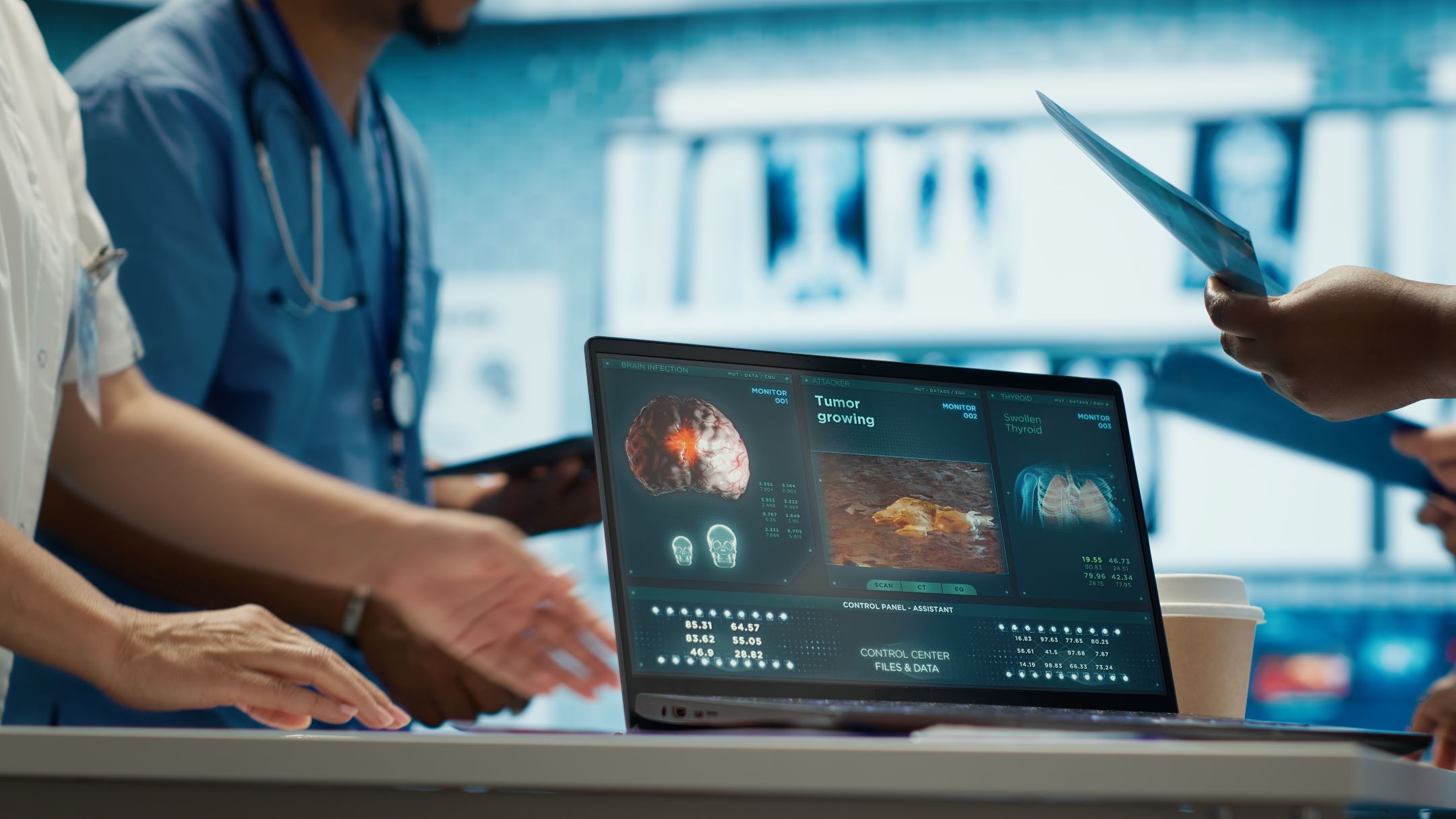
A surgeon using gesture control to navigate diagnostic imaging during a procedure does not need to break sterile protocol to scroll through scans. The gesture layer recognises the hand movement, confirms intent through gaze direction, and responds without a second staff member manning the console.
Scenario Two: Next-Gen HMI in the Fleet Telematics
In a commercial fleet vehicle, an adaptive dashboard can suppress non-critical notifications when sensor data indicates high cognitive load, such as a complex lane merge in heavy rain, then surface them once conditions normalise.
The same dashboard, in a static implementation, would force the operator to filter information manually at the exact moment they can least afford to do so.
Implementing Next-Gen HMI into Display Hardware
This is also where display hardware becomes part of the intelligence story. Advances in flexible and transparent displays are allowing dashboards, cockpits, and industrial terminals to place contextual information directly in the operator's line of sight without occluding their view of the physical environment. A transparent head-up display that shifts content based on gaze direction is a different class of interface to a fixed screen mounted below eye-level.
The implication for the underlying hardware is straightforward. Running input arbitration, computer vision, and voice understanding all at once requires processors built for low-latency work in compact, heat-sensitive environments. The chip, the thermal design, and the power budget have to be engineered together from the start.
The Hardware Reality of Multimodal HMI Manufacturing
Next-generation HMI manufacturing is constrained by what the board can physically accommodate. Multi-layer PCB designs must fit sensor processing, display controllers, AI co-processors, and power management into compact form factors that often have very little room for heat dissipation. The board has to survive in a cabin at 70°C or on a factory floor with constant vibration.
Three hardware considerations define whether an MMI design can be produced at scale without compromising signal integrity or long-term reliability:
- Processing headroom for concurrent AI inference: Gesture recognition, voice transcription, and sensor fusion often run in parallel. The compute architecture has to support all three without thermal throttling under sustained load.
- Power efficiency across multiple low-power modes: Battery-dependent and thermally constrained deployments, from portable medical devices to EV cabin systems, require granular power-state management to keep edge AI active without draining reserves.
- Display interface flexibility: Modern dashboards routinely run dual or triple outputs, combining instrument clusters, central displays, and passenger screens on a single controller. Display bandwidth and electromagnetic interference (EMI) shielding become core design constraints, not afterthoughts.
This is where the working relationship with an Electronics Manufacturing Services (EMS) partner determines whether a product is production-ready or a design cannot survive its first thermal cycle. Surface Mount Technology (SMT) tolerances, Design for Manufacturing (DFM) discipline, and early-stage collaboration on component placement determine whether the design survives the transition from prototype to volume.
The design challenges around intuitive features, particularly around electromagnetic interference between capacitive touch layers and adjacent RF components, are resolved at the board level, or they are not resolved at all.
Engineering the Future of HMI

The future of HMI is defined by coordinated input fusion, edge AI arbitration, and hardware precision. No single interface modality wins. The system that fuses them wins, and it only works if the underlying hardware can sustain concurrent processing loads within the thermal, power, and signal-integrity envelopes imposed by each deployment environment.
With more than 30 years of EMS experience across industrial, automotive, medical, and consumer electronics, PCI combines deep HMI design expertise with the manufacturing discipline required to bring multimodal interfaces from prototype into volume production without compromising performance.
Our integrated HMI capabilities include:
- Custom display and interface design: From capacitive multi-touch panels to gesture-ready sensor arrays, we engineer HMI hardware tailored to the operating environment, whether that is a sterile medical console, a vibration-heavy industrial terminal, or a high-temperature vehicle cabin.
- Multimodal sensor integration: Our engineers integrate voice, touch, gesture, and proximity sensing onto unified PCB designs, resolving the EMI, thermal, and signal integrity challenges that arise when multiple input modalities share a single board.
- Edge AI-ready hardware platforms: We design around high-performance processors from industry partners including NXP and MediaTek, giving next-gen HMI products the inference headroom needed for concurrent modality arbitration without thermal throttling.
- Design for Manufacturing (DFM) and Design for Excellence (DFX): We embed manufacturability and testability into HMI designs from the earliest stages, reducing rework and accelerating the path from first prototype to production-grade yield.
- Precision SMT assembly and quality assurance: Surface Mount Technology lines calibrated for tight-tolerance HMI assemblies, supported by In-Circuit Testing (ICT), functional validation, and environmental simulation to confirm reliability under real-world operating conditions.
As your HMI manufacturing partner, PCI provides the design-for-manufacture expertise, SMT capability, and EMS rigour that next-gen HMI products depend on to reach volume production without compromising on performance. Contact us today to discuss how our HMI capabilities can support your product roadmap.
Frequently Asked Questions About Multimodal Interfaces
What is an example of a multimodal system?
A multimodal system combines two or more types of input, such as voice, touch, gesture, and gaze, into one coordinated interface. The Mercedes-Benz MBUX system is a well-known automotive example: drivers can issue voice commands, use the touchscreen, and perform steering-wheel gestures, with onboard AI deciding which input to act on at any given moment. A second example sits in industrial settings, where smart factory control terminals accept both touch and gesture inputs, with proximity sensors that lock the display when the operator steps away from the station.
What is the difference between multimodal and multichannel UI?
A multimodal UI is a single interface that accepts multiple input types at once, such as voice, touch, and gesture, and combines them into one coordinated response. A multichannel UI is different: it uses several separate interfaces, for example, a mobile app paired with a physical control panel, that operate independently and do not share information with each other. The defining difference is input fusion, not channel count. A product can offer five channels and still not qualify as multimodal if those channels cannot talk to each other or share context in real time.